
Ukugula kwabantu: Building bridges between biomedicine and the African healing traditions of Southern Africa
Trained as a drama therapist at New York University, I initially questioned how my American training would equip me to work within the South African context. As the first Black drama therapist in Africa, it was crucial for me to understand what therapeutic interventions would be appropriate for Black individuals in South Africa. Concurrently, my role as a traditional healer required me to navigate my dual identity. Completing this PhD emerged as a significant task, one that I believe was guided by ancestral calling, aimed at deepening the understanding of indigenous knowledge systems and their revitalization within South Africa’s cultural landscape.
Initially, my research question was, “How do traditional healers construct mental health?” My aim was to explore African perspectives on mental health and disease, which are deeply intertwined with the nature of knowledge as shared and negotiated within African cosmology. I argued that understanding the paradigm of traditional healers is crucial for comprehending how reality, knowledge, and the human experience are conceived within African metaphysics.
However, as I engaged with traditional healers, it became clear that my initial focus on the concept of mental health, which I had imported from a Euro-American framework, was not entirely relevant. The healers’ responses highlighted that my questions needed redefining. The dialogue shifted away from mental health as a predefined category and centred more on their personal life stories and practices, revealing a richer, more contextualized understanding of their worldviews and approaches.
Despite the increasing mental health burdens and challenges in South Africa, mental health services are severely under-resourced, and numerous barriers impede access to care for those with mental health issues. These barriers include service acceptability and availability, stigma and discrimination, language barriers, culturally incongruent models of mental health care, and concerns about efficacy. Research indicates that traditional healers can play a crucial role in addressing mental health challenges, as they provide care rooted in indigenous explanatory models of illness widely held by many South Africans.
I argue that optimizing collaboration with traditional healers within the South African healthcare system could offer a more sustainable approach to mental health care. This research aims to enhance the understanding of local phenomena and broaden our perspective on psychological functioning across diverse cultures. Additionally, it challenges the marginalization of indigenous medicine, which often stems from the perceived superiority of biomedicine. Thus, this project contributes to self-definition and self-determination, expanding our knowledge of the world and the human experience.
I employed a qualitative phenomenological research methodology, conducting semi-structured interviews with nine traditional healers in and around Chiawelo, a peri-urban area in Johannesburg. The healers, aged between 29 and 74, had varying levels of experience, ranging from 2 to 52 years. The group comprised 2 males and 7 females, representing a mix of ethnicities, including Shangaan, Venda, Zulu, and Sotho. Their professional identities varied: 4 identified as sangoma, 3 as both sangoma and inyanga, 1 as inyanga, and 1 as both sangoma and umthandazi[1].
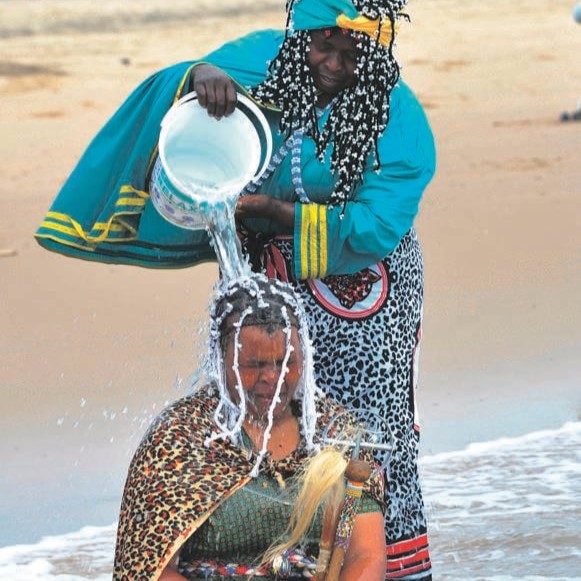
In addition to interviews, I conducted ethnographic observations in Chiawelo, including at the Chiawelo Community Health Centre, late-night music jam sessions, and during an initiation ritual at a traditional healer’s home. These observations provided insight into the socio-cultural, socio-political, and socio-economic contexts of the healers’ lives. To deepen my understanding of the traditional healing paradigm, I engaged in auto-ethnographic practices through my participation in traditional healing initiation and training rituals.
My research primarily consulted literature on African metaphysics, psychology, anthropology, and medical humanities, including studies and autobiographies of traditional healers. Additionally, I reviewed radio interviews, social media posts, and YouTube videos to contextualize traditional healing practices and understand contemporary concerns within the imaginary of black South Africans in the twenty-first century.
The primary finding of my research was the realization that my initial question was misaligned. This insight highlighted the disconnect between academic frameworks and theories, which are often rooted in Euro-American conventions, and the perspectives of marginalized, predominantly indigenous communities. The traditional healers I interviewed did not recognize mental health as a separate category of health, as it is conceptualized in the Euro-American framework.
Instead, I discovered that health is understood through a complex and holistic African metaphysical perspective, emphasizing interdependence and cosmic unity. This perspective underscores the interconnectedness between creator beings, divinities, ancestral spirits, humans, animals, plants, and inanimate objects. It portrays a continuous dialogue among these entities, each capable of influencing and interacting with one another. The view of the human as existing simultaneously in material and immaterial realms reflects this ongoing dialogue with their cosmology, impacting both inner processes and overall health.
Through analysing how traditional healers characterize disease causation, I identified five categories:
- Ancestral Causation: This includes themes related to the ancestral call, issues of power, and ancestral rituals.
- Human Development: Focused on rites of passage and their impact on health.
- Psychosocial Causation: Encompasses witchcraft, poverty, inequality, violence, and substance abuse.
- Ecological Causation: Examines the intricate relationship between humans and their environment.
- Natural Causation: Refers to bodily and chemical interactions affecting health.
These categories are deeply interconnected. Contrary to the belief that traditional healing is merely based on superstition, my findings demonstrate that traditional healers employ a comprehensive and systematic approach to assessing and treating health issues.
[1] A chapter in my thesis argues against the term traditional healer, suggesting that this term negates the dynamism and heterogeneity of the practice. These are different types of healers, the names used to indicate their area of specialization. For a more comprehensive outline my thesis can be accessed here.
 Science Religion and Health